Category Archives: science fiction

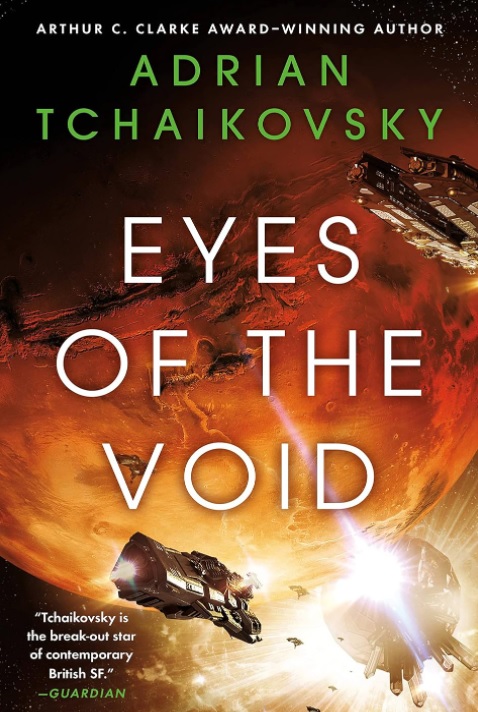
Eyes of the Void (The Final Architecture 2) by Adrian Tchaikovsky

Sponsored Link

Stars: 4.5 out of 5

You would think that when different factions and races that make up intelligent life in the galaxy discover that the Architects are back, they would put aside their petty squabbles and unite in the face of an overwhelming enemy, right? Well, you would be wrong.

The Architects are back and this time they are destroying inhabited worlds regardless of the species who live on them, whereas before they only concentrated on human worlds. Heck, even the Hegemony isn’t protected by their Originator relics anymore. But instead of uniting and fighting together, humanity is shattering and descending into an inner conflicts. HUGH and the Partheni are at each other’s throats and the smallest spark can ignite a powder keg of mutual destruction…

It’s interesting to see that all the characters in this book struggled with their loyalties to their respective factions versus their own moral code and what they thought was the right thing to do. Idris defected to the Partheni at the end of the last book because he hoped that they could engineer Ints without subjecting people to the horrible programs that HUGH had put in place. Programs that have over 80% mortality. And the surviving Ints are broken beyond repair, and are no better than slaves. But when a war between HUGH and Partheni seems eminent, he struggles with this decision. Is he a traitor for abandoning the Colonies? Of course, soon that consideration becomes rather irrelevant, at least to him.

Solace and Olli have their own doubts and crisis of faith moments as well, but ultimately, I love that their first loyalty is to their found family on Vulture God as well as humanity as a whole instead of a particular faction their originated from. 

We also learn a lot more about the universe, the structure of Unspace and its relation to our real space, oh and a little bit about the foreboding presence that stalks whoever enters Unspace. 

I was also impressed with the few planets described in this book. The destruction of Arc Pallator by the Architects after they removed the Originator ruins was epic. Especially considering that our characters were smack in the middle of it, running in said ruins. That was an amazing and heartpouding sequence of events.  And Criccieth’s Hell is truly a hellish world. 

My only complaint about this book is that the characters seem a lot more passive than in the first book – things happen to them, and they just react to that instead of being a driving force behind the story. This is especially true of Idris, who spends the whole book being a magic McGuffin that everyone tries to kidnap.

This small complaint notwithstanding, I enjoyed this book, and I am looking forward to the last book in the series.

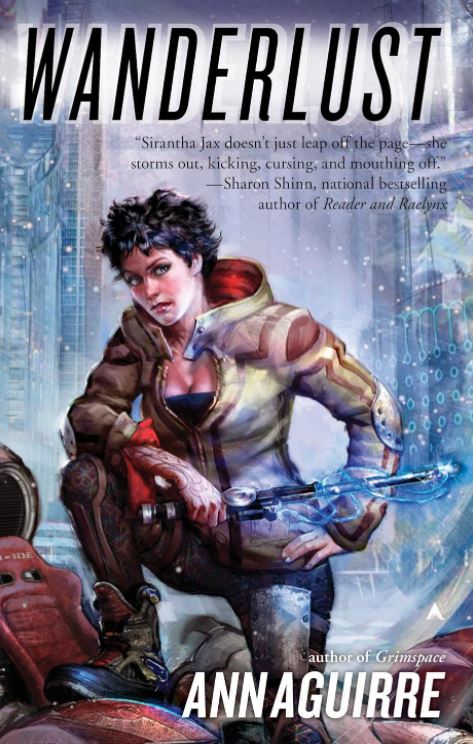
Wanderlust (Sirantha Jax 2) by Ann Aguirre

Sponsored link

Stars: 3 out of 5.

I liked this book better than the first one, probably because I was already somewhat familiar with the world, so I wasn’t as lost. Plus, the story progresses from the events of the last book, and our protagonist’s actions have some very real consequences.

I am less annoyed with Sirantha in this book as well. She is still an emotional wreak, but she seems more self-aware at least. And she is finally becoming a lot less selfish then she was in the first book. I think she finally realized that she isn’t just a jumper anymore who has no other responsibilities than to get the ship from point A to point B through Grimspace without loosing anyone in the process. Even if in the beginning she only accepted the mission of ambassador to get off planet (and frankly because she didn’t have two coins left to rub together), by the end of the book she started taking this mission very seriously.

I think seeing the Morgut infested space station had a lot to do with that change of heart. You can’t really remain selfish when you realize that there is a species out there who thinks humans are delicious, and destroying the Conglomerate just rang the dinner bell. Honestly, I think the segment of them exploring that space station was the best part of the book. It was scary and intense, and reminded me of some of the best space horror titles I read this year.

I still have issues with Sirantha’s and March’s relationship though. It feels very unhealthy to me. I mean, they claim to love each other unconditionally. To always be there for each other and all that stuff. Yet, they can’t talk things through when they hit a difficult bump on the road and get their feelings hurt. Or just plain abandon the other because someone else needs them more. I’m trying to avoid spoilers here, but I honestly still can’t understand March’s decision on Lachion. Probably because I didn’t give a flying fig about the war between the clans on that planet. Honestly, that part of the book was a slog to read. 

What I am saying is that I don’t understand why the author keeps pushing these two characters together when they are obviously toxic for each other. If that’s her idea of a perfect relationship, I will have a problem with the rest of the books. I like my relationship on the non-abusive spectrum. 

Oh, and the whole subplot about Jax’s mother was very far-fetched in my opinion. Are you honestly expecting me to believe that in all those years Sirantha was growing up, she never noticed that her mother was at the head of a crime syndicate? Right…

However, I am interested enough in the worldbuilding to give the next book a try. If nothing else, I really want to know how they will resolve the Morgut problem. I am also interested to learn a bit more about Grimspace, and why Sirantha can sense it even when not jacked up.

Gideon the Ninth (The Locked Tomb 1) by Tamsyn Muir

This is a sponsored link.

Stars: 4 our of 5.

This was a very bizarre book set in a weird world, and I loved every minute of it! A one sentence summary for this story would be – Necromancers in Space, but that doesn’t do this book justice. 

I came into this book with no small amount of trepidation, because opinions were very divided about it amongst my Goodreads friends. Some adored it, some couldn’t stand it, some DNFed it halfway through. I now can proudly admit that I am in the “adored it” camp.

I think the biggest surprise for me was just how attached I grew to all the characters. I grew to love all of the necromancers of various houses and their cavaliers. It was interesting to observe their interactions as well as ties that kept the different pairs together. And some of the characters I even enjoyed hating, like the unbending militaristic Second house, or the scheming Eight. 

The slower pace of the book in the first half helped create that effect – the author takes her time first showing us the abysmal life that Gideon lived in the Ninth house, and the decrepitude it was slowly falling into. That way I clearly understood why Harrow was so desperate to answer the summons, or why Gideon would agree to come along, even though she hated her guts. 

By taking time to introduce us to the different characters and explore the strange palace they find themselves in, the author makes us care for everyone. Even Teacher with his perpetual good humor. So when the horrors start happening and the first deaths occur, it hits the reader like a punch in the gut. Especially since it happens to the characters that are the most sympathetic of them all.

The ending is also heartbreaking. I wanted so badly for Gideon to finally break free from the clutches of the Ninth house. I’m glad that her and Harrow finally aired all their grievances and made piece before the final confrontation with the big bad of the book. So Gideon’s sacrifice came as a natural conclusion of that story. It made sense. It was the only way Gideon could act at that time. It was still heartbreaking.

I wish we got a few more answers by the end of this book. Where did Gideon come from? Why was there mentions of her name in this palace? Why can’t the Emperor set foot on the planet again? What was the force lurking beneath the place that Teacher was so afraid of? I doubt we will ever get the answers to these questions now, since this story seems over.

I will however continue with this series because I want to know what force in the galaxy is more terrifying than a whole empire of necromancers.

Travel by Bullet (The Dispatcher 3) by John Scalzi

Stars: 4 out of 5.

I liked this novella – it’s perfect for a lazy afternoon when you don’t particularly want to commit to a longer book. It’s fast-paced and engaging, and still manages to deliver a decent portion of worldbuilding.

And what a fascinating world it is. Imagine a world where murder doesn’t exist anymore. And by that I mean that a murder victim will reappear in a place they consider safe and will be unharmed, though will retain the memory of the murder. Oh, that doesn’t eliminate death in its entirety. Accidents still happen, and illness, but murder? in 99.99% of the cases, the victim will be alive again. 

It’s interesting to see the changes that this brings to society. And to see the good and bad that this brings in humanity. 

On one hand we have government sanctioned dispatchers whose sole job is to murder people who would otherwise die a permanent death so that they have a second chance. For example, someone is in a bad car accident and is moments from dying. The doctors can’t save them fast enough. If the dispatcher murders that person, they have a 99.99% chance to reappear at their home safe and healthy, like the accident never happened. Sure, there is that little 0.01% chance that they will fail to reappear, but that’s better than certain death, don’t you think?

On the other hand, we have people who use their power and influence to make others compete to the death to gain their favors, be it a lucrative construction contract, a job position or a refence that the other person needs. It is immoral and frankly horrifying. So what if the murder victim will technically survive? Both the muderer and the victim will still keep the memories and the trauma of the event.

This is my second foray into this series, since I read the first book, and I must admit that I’m loving it. The concept is original and I enjoy watching where the author will take it. I will definitely also check out the second book that I somehow missed.

My only complaint about this particular book is that the main characters is a bit bland. We really don’t get to see what makes him tick. I still don’t know what his motivation is in doing what he is doing.  But since I love the concept so much, I am willing to forgive a blah protagonist.

PS: I received an advanced copy of this book via NetGalley in exchange for an honest review.

Paradise-1 (Red Space) by David Wellington

Stars: 2.5 out of 5.

I was fully onboard with this book for the first 50% or so of the story. Granted, one of the main characters was too stupid to exist, and some of her choices were that of a braindead child. But the story moved along at a good pace, things were happening, there was a big mystery about, so was happy to overlook an annoying character or two. But then the book kept going… and going… and going with no end in sight. Episodes started repeating themselves without bringing anything new to the story, and I was quickly losing interest. 

As I had mentioned, the characterizations in this book are… rather lacking. And forget about character growth. I think the only character that has any is Rapscallion, and he is a sentient robot. Which tells you everything you need to know about the other characters. So if you are looking for a character driven story, move along. This ain’t for you.

But the mystery of what the heck is happening around Paradise-1 and why all ships sent there stop responding was compelling enough to have me turning the pages for about half of the book. And I admit that the idea of an alien contract that can invade our minds by planting a destructive idea is rather horrifying, because our bodies have no defense against a virus that isn’t biological in nature. I also really wanted to discover what was on Paradise-1 that needed to be guarded so fiercely, and why was it worth so many human lives and so many ships to try and get it.

Unfortunately, this book is at least 300 pages too long, so the story started repeating itself. We get to yet another ship that’s infected with different version of the Basilisk. We encounter yet another crazy AI and see the horrors that happened to the human crew. We don’t learn anything that we didn’t know by reading the first half of the book. The characters flee the ship, or are saved, or take the ship over… then the action switches to yet another encounter with another infected ship. Honestly, I think the story should have ended after their attempt to run the blockade to land on the planet. The 200 pages after that were just filler, with a few exception, like actually encountering the Basilisk, and even that could have been incorporated into the story differently. 

Oh, did I mention that the book ends on a cliffhanger? No? Well, it does. 700 + pages end with no emotional payoff whatsoever. We still don’t know what happened on Paradise-1 and why it was so important to get there. The story ends mid-action.

I guess the reader would have to pick up the next book in the series to find out what happened to the colony on Paradise-1, but guess what?  I won’t be along for the ride. I am not willing to sit through another overlong book and follow annoying characters just to find out that the story isn’t finished and there is another cliffhanger. No thanks, I’m out.

PS: I received an advanced copy of this book via NetGalley in exchange for an honest review.

In the Lives of Puppets by TJ Klune

Stars: 5 out of 5.

I rarely read fairy tale retellings, because I think that retellings are rather pointless. I’d rather read the original and decide for myself what the morale of the story was, instead of reading about what the reteller thinks the story was about. So I’m really glad that I didn’t know that this was a retelling of Pinocchio when I picked up the book, or I would never have given it a try. And I would have lost out on a wonderful story.

And honestly, you don’t have to know anything about the original Pinocchio book to enjoy this story. Yes, there are parallels, but In the Life of Puppets stands on its own two feet pretty well and doesn’t rely on knowledge of the original.

It’s a story of Victor Lawson, the only human in a world of robots. And of his quest to save his father. And him and his friends have some adventures along the way. 

For a fairy tale this book has surprisingly a lot of heart. Because the characters, human and robot alike, are fully realized individuals with their own quirks and dreams. And their interactions are hilarious at times, and at times very touching and heartfelt. Nurse Ratched is my favorite character. Yay for sociopathic nurse robots with a heart of gold. 

The world our group of misfits travels through is wonderous and terrible at the same time, like it should be in good fairy tales. And all of the characters grow and progress along the way, especially Victor, who has to come to terms with a lot of hard truths. Like the fact that his father was the engineer of the extinction of his whole race. Or that you can still love someone even if you can’t forgive them for what they did, even if you aren’t sure you have the right to forgive them.

Or that you can love someone even if they don’t remember you from time to time. This last one hit particularly close to home, since I am dealing with a relative slowly loosing his battle with Alzheimer’s. That is a truly horrible disease that transforms a loved one into a completely different person. A bit like what happened to Gio once he was taken back into the City of Electric Dreams.

And even though the situations our characters find themselves in are horrible at times, the overall message of this book is one of love and hope, which makes it a very heartwarming story. I would definitely recommend this to adults and young adults alike. It’s rare that I read a book in one sitting and come out of it with a content and warm feeling.

PS: I received an advanced copy of this book via NetGalley in exchange for an honest review.

Centers of Gravity (Frontlines 8) by Marco Kloos

DNF at 45%.

I love me a good space opera from time to time. Heck, I’m both a Star Wars and a Star Trek fan. I watch and read plenty of scifi. Problem is, I want my space opera to be, if not smart, then at least entertaining, with a good story and relatable characters I want to invest my reading time into. Not the case here.

The characters here are absolutely lifeless. In fact, I would go so far as to say that they are not characters at all, but cardboard cutouts with a series of threats needed by the author to progress the story. Heck, even the protagonist is so bland that I can’t remember his name a week after I gave up on this book. We don’t know his motivations, we don’t know his needs or wants, or even his fears. Yes, we are told that he is married and misses his wife, but it’s told in such a clinical manner that there is no sentiment behind it. The side characters are even less defined.

My other problem is that there really isn’t much of a female representation in this book. And the little we have are either guys in skirts, or a guy’s wet dream. Which we often see in books written by men, unfortunately. It takes talent to create tridimensional characters, especially those of the opposite sex. And effort. In my opinion, the author simply didn’t put in the effort here. Which might be okay for some if action is all they had come for. Unfortunately, action is usually not enough for me.

Speaking of action, this book takes way to long to set up the stage for it. The first 30-40% is basically set up where nothing happens. Characters fly through space. Characters talk. Characters walk. Characters make plans. It can be made interesting if the characters were interesting which is not the case here. 

The writing is… serviceable when it comes to description and action scenes, but sucks when it comes to dialog. All characters sound the same, which, since they have no personality to speak of, is not surprising. But the dialog also doesn’t sound natural. People don’t speak like that, even in the future. This is when I’m glad that I don’t listen to audiobooks, because good luck trying to instill life into those conversations. 

In summary, this is definitely not for me. I mean, the action might be phenomenal in the second half of the book, but I didn’t care enough to stick around for it.

PS: I received an advanced copy from NetGalley in exchange for an honest review. 

Lost in Time by A.G. Riddle

Stars: 1.5 out of 5.

Pfew, glad I’m finally done with this book. It’s not particularly long, but boy it dragged. 

Truth be told, I only picked it up because the blurb promised time travel and dinosaurs. Unfortunately, there is precious little of them in this story. And that timeline is completely ignored for the last 50% of the book, much to my disappointment. Also, how can you make a story of survival at the time of dinosaurs boring? I thought that was impossible.

The characters are also nothing to write home about. And what I mean by that is that they are lifeless. They are just concepts with a few distinct traits and flaws to differentiate them by, not real fleshed out characters. Adeline is the worst offender in this department. Too bad she is the one we follow the most in this book. By the time the author completely drops Sam’s story at the time of the big reptiles and focuses solely on Adeline and her valiant attempt at making her life even more boring than it was, I was sorely tempted to just DNF this book. But I had already read about 67% of the story, so I felt bad for my time investment and wanted to at least see this through and find out what this murder mystery was all about. 

Spoiler alert – it makes no sense whatsoever. Turns out the murder is not really a murder, so all the pain and suffering for Sam and Adeline was for no good reason at all. Also, that whole plot twist with Adeline’s time travel served no particular point either. 

And the ending… don’t start me on the ending. Are we really supposed to think that his little utopia island of theirs is supposed to be a paradise on earth? These people are effectively prisoners there until they die. How long before some of them decide they had enough and stage an insurrection? 

Also, what was the point of this story? The murder wasn’t really a murder, so the driving factor behind all this is moot. The end result is also deeply unsatisfying. 

The writing stile was also very dry and impersonal. That coupled with one-dimensional characters made it very hard to stay engaged in the story or to care about what was happening at all. I don’t think I will pick up another book by this author.

PS: I received an advanced copy via NetGalley in exchange for an honest review.

The Last Storm by Tim Lebbon

Stars: 2 out of 5.

This book tried to marry two different ideas in the same story – a climate disaster story and a story about people with a special ability that ties them to a different world/dimension. I think the author wanted to pay homage to Stephen King and his many books that did the same thing.  Lisey’s Story comes to mind. That was one creepy and fascinating book.

Unfortunately, where Stephen King managed to marry the weird and the mundane into a seamless buildup of creepiness, this author failed, in my opinion. 

I think it stems from the fact that the power the Rainmaker family has is never truly explained or explored other than as a tool to rain disaster and death on an already ravaged country. That and the fact that it is described almost like a drug, an addiction, makes it really unpredictable and unattractive. 

Also, it is never truly explained how that power is tied to the horrible draught that is killing a vast part of the States, of if there is even a connection. And if there isn’t a connection, then what’s the point of this power in the story?

My other issue with this book is that all the characters are unlikeable, especially Ash. I mean, I was pretty interested and invested in her story while she was on a quest to assemble her device and make it rain… Until at about 61% in the book where she unleashes rains of blood and horrors upon this town, kills several people… and has absolutely no remorse about it. That’s where she lost all my support, as well as my desire to continue following her story.

I also don’t understand why everyone else is making excuses for her behavior. Oh, she is so special. She can make rain out of a clear sky… Yes, she can also unleash venomous creatures that attack everything in sight along with that rain. Oh, and by the way that rain will turn into a deluge that will make matter so much worse. 

Of the other protagonists we have Ashe’s father, who is a coward who’s response to a traumatic even had been to hide his had in the sand for almost a decade. Her mother who turned her whole life into an obsession. An ex-addict turned into Ash’s insta-groupie. And a psychopatic killer. Honestly, not a single one of them is likeable or even relatable enough follow into the story. 

I think I would have enjoyed this more if Ash wasn’t such an unrepentant addict who made excuses every time she messed things up. Or if the supernatural element was better tied into the rest of the story.

PS: I recieved an advanced copy of this book via NetGalley in Exchange for an honest review.

Neptune’s Brood (Freyaverse 2) by Charles Stross

Stars: 3.5 out of 5.

First, I need to point something out for those who just finished the first book in the series. The sequel has absolutely no ties to the first book, apart from happening in the same universe, so be warned if you expect to learn more about Freya – she isn’t even mentioned in this book. My husband launched into this book right after he finished the first one, and he didn’t enjoy it as much precisely because of this. He said the disconnect was too big at the beginning of the book – it is the same universe, but all the characters are new. 

I, however, started book 2 about a year after I read book 1, so I didn’t mind the fact that we are told a completely different story a few thousand years in the future from the events of the first book as much. Sure, I would have loved to find out more about Freya and her sibs, but I was happy enough to explore this new evolution of the world introduced in book one.

And it’s a fascinating world where humanity (at least a variant thereof) spread into the stars and created a vast society of colonies almost everywhere in the universe close to their point of origin (Earth). I found the structure of their society fascinating. When warp drive or hyperspace or faster than light travel don’t exist, interstellar travel takes dozens, sometimes hundreds of years. Even laser uploads via laser arrays, the fastest form or interstellar travel, takes dozens of years. It’s fascinating to read about a society that thinks in scopes of centuries and even millennia when founding a new colony or engaging in any type of financial transaction.

The whole financial and economical system is very interesting as well, and, as far as I remember, this is the first science fiction story in which this aspect of a society is explored in so much detail and is so integral to the story. In fact, it’s a little bit too integral to the story, and the endless explanations on how slow money works and different fraudulent manipulations thereof were a bit tedious to go through after a while.

The biggest problem of the book, at least for me, was the main protagonist, Krina. She is a very passive character that reacts more than acts on her own. For the duration of the book, she had been a victim of the circumstances, kidnapped, altered, thrown into the deep end of a water planet, etc. And when she finally gathers enough power to have her own agency… the story ends. That was very disappointing, especially when you compare Krina to Freya from the first book.

Despite this, I thoroughly enjoyed this story, even if I could have used a little less exposition about the different financial instruments. This is definitely a series worth your time and effort.