Category Archives: Military science fiction

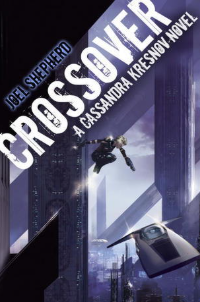
Crossover (Cassandra Kresnov 1) by Joel Shepherd

Amazon link (sponsored)

Stars: 2 out of 5

I was so excited about the premise of this book. As I said – a military android who realized that she wanted no part in the war between the League, who created her, and the Federation, and defected to live a normal, civilian life. But even fleeing to a seemingly neutral planet of Tanusha, Cassandra ends up in the thick of secret plans within plans between the same two actors she tried so hard to distance herself from.

This should have been a heart-pounding thriller ride! Instead, I fell asleep and dropped my phone on my face at least five times while I slogged through this book. How can I book about a badass android who defected from the side that created her and ended up embroiled in a conflict on the world she ran to be so boring? It’s over 400 pages long, and trust me, almost every single one of those pages dragged.

One of the reasons is that the pacing is so uneven. We get moments of action when Cassandra is either in the thick of things or being pursued or doing some pursuing of her own. Those are exciting enough, even if they could have been more tightly written. The problem is, they are few and far between. And between them, we get a lot of Cassandra gazing at the city of Tanusha, Cassandra and other characters talking politics, human relations, and racism, or Cassandra thinking about sex or engaging in sexual activities. On and on, without adding anything meaningful to the story.

This brings me to my other issue with this book. Despite a lot of talk of politics, I still have no clue what the conflict between the League and the Federation was about. Why is the League losing the war? Why did they decide to cooperate with the Federation enough to literally turn over their very unique android model? It’s all vague references and a lot of circular talking, and no real answers. If I don’t know what caused the conflict, I don’t care about the conflict or either of the parties.

The whole worldbuilding is pretty shaky in this book. We are probably a few hundred years into the future (or thousands). Humanity seemingly colonized a lot of solar systems. Yet people still divide themselves by Earth race and religion? Why would it matter to a Tanushan that someone is Muslim or Hindu? In fact, how would you even practice your religion on another planet? Where is Mecca in regards to the planet you are on? In that respect, the world of The Expanse is a lot more credible. People stop being from China or America, or India by the second generation born on a new world. Instead, there would be Earth, Mars, the Belters, etc.

All in all, this was a boring and rather disappointing read, and I will not be continuing with this series. But at least I crossed another book off my TBR list.

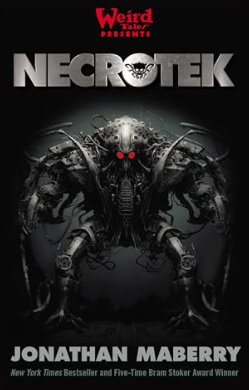
Necrotek by Jonathan Maberry

Amazon link (sponsored)

Stars 3.5 out of 5

This is the second book based on the Lovecraftian mythos that I’ve read this year, the first being A Plagued Sea by Kim Bo-young. Despite drawing from the same source material, the two books couldn’t be more different. One leans into existential horror, while this one is firmly in the military-action horror camp.

The book starts strong. A space station filled with military personnel, journalists, scientists, and representatives from various Earth religions gathers to witness the test of a new warpline gun. Naturally, the test goes horribly wrong.

I have to admit that the chapters covering the test and the immediate aftermath of Asphodel Station’s transport were genuinely chilling. Space, time, and even reality itself begin to warp and collapse, confronting people with horrors that are both real and born from their own minds. That’s nightmare fuel right there.

The first encounter with the shoggoth was also an edge-of-your-seat read. The action scenes throughout the book are well written, with plenty of tension and high stakes.

Unfortunately, the frequent info-dumps kill a lot of that momentum. I found my attention wandering, even during major action sequences, because they were constantly interrupted by exposition, existential crises, or “meaningful conversations.” The fight with the shoggoth vanguard is a good example—the action repeatedly stalls while Soren reflects on the Necrotek and wrestles with his doubts.

Speaking of necrotek, we have to wait until almost 80% of the book before that technology actually comes into play.

That said, I did like the characters. Soren tends to proselytize a bit more than I personally enjoy, but the cast is generally strong. I especially loved the Lost Souls and found myself rooting for them, even though a group with a name like that practically announces its fate from the beginning. Surprisingly, my favorite character ended up being Sybil. For an AI, she’s incredibly likeable. I also understood Lost’s desperation. It is the last survivor of a long-forgotten race, and the enemy they once fought has returned with a vengeance.

The ending clearly leaves the door open for a sequel, and I’ll probably pick it up. I just hope this book got most of the world-building out of the way so the next installment can focus a little more on action and a little less on exposition and philosophical reflection.

PS: Big thanks to NetGalley for providing me with an advanced copy.

Rubicon by J. S. Dewes

Amazon link (sponsored)

Stars: 3 out of 5

I loved this book… until the twist at the end and the cliffhanger ending. Honestly, it destroyed the book for me. That ending made everything that came before it useless. All the sacrifices, all the shit Valero went through was literally for nothing because the author decided that a particular twist at the end would be a clever thing to do.

Yes, I’m pissed. I was deeply emotionally invested in these characters. I was rooting for them. Ending a book this way feels like a slap in the face. Why the heck did I spend hours of my life reading this when NOTHING the characters did had any meaning?

Adrienne wasn’t a particularly likable character in the beginning, but there was a reason for that. That reason was revealed to the reader in all its traumatic glory very early on. Rezoning is a horrible technology that leaves a scar on one’s psyche. Imagine doing it 96 times in 10 years. Frankly, I’m surprised she isn’t more messed up than she is.

It was a rewarding journey to see her overcome the apathy, to face her demons, and start finally experiencing human emotions again – care for others, open up enough to love someone, and create friendships. Be scared of zeroing out her friends.

In this light, the ending pisses me off even more, because all her sacrifices have been for nothing. There is no emotional payout at the end of this book.

PS: I received an advanced copy of this book via NetGalley in exchange for an honest review.

Centers of Gravity (Frontlines 8) by Marco Kloos

DNF at 45%.

I love me a good space opera from time to time. Heck, I’m both a Star Wars and a Star Trek fan. I watch and read plenty of scifi. Problem is, I want my space opera to be, if not smart, then at least entertaining, with a good story and relatable characters I want to invest my reading time into. Not the case here.

The characters here are absolutely lifeless. In fact, I would go so far as to say that they are not characters at all, but cardboard cutouts with a series of threats needed by the author to progress the story. Heck, even the protagonist is so bland that I can’t remember his name a week after I gave up on this book. We don’t know his motivations, we don’t know his needs or wants, or even his fears. Yes, we are told that he is married and misses his wife, but it’s told in such a clinical manner that there is no sentiment behind it. The side characters are even less defined.

My other problem is that there really isn’t much of a female representation in this book. And the little we have are either guys in skirts, or a guy’s wet dream. Which we often see in books written by men, unfortunately. It takes talent to create tridimensional characters, especially those of the opposite sex. And effort. In my opinion, the author simply didn’t put in the effort here. Which might be okay for some if action is all they had come for. Unfortunately, action is usually not enough for me.

Speaking of action, this book takes way to long to set up the stage for it. The first 30-40% is basically set up where nothing happens. Characters fly through space. Characters talk. Characters walk. Characters make plans. It can be made interesting if the characters were interesting which is not the case here. 

The writing is… serviceable when it comes to description and action scenes, but sucks when it comes to dialog. All characters sound the same, which, since they have no personality to speak of, is not surprising. But the dialog also doesn’t sound natural. People don’t speak like that, even in the future. This is when I’m glad that I don’t listen to audiobooks, because good luck trying to instill life into those conversations. 

In summary, this is definitely not for me. I mean, the action might be phenomenal in the second half of the book, but I didn’t care enough to stick around for it.

PS: I received an advanced copy from NetGalley in exchange for an honest review. 

Atlas (Atlas 1) by Isaac Hooke

DNF at 67%.

Every once in a while, I pick up a military scifi book, because the description or the cover spoke to me. Also, just to see if I might like it. With rare exceptions, like the Old Man’s War by John Scalzi, those books are a disappointment. Unfortunately, this one will fall into that disappointment category as well. 

What I want in the books I read is good characters that are interesting to follow (even if not necessarily likeable), and a good story that doesn’t have too many glaring plot holes. A modicum of internal logic with the worldbuilding is also highly appreciated. As you can imagine, military scifi is a genre that is very light on all of those attributes. 

This story is typical military scifi fare – light on worldbuilding and substance, but hey, we have cool giant robot suites for our protagonist to pilot. The protagonist is also a typical representative of the genre – a wisecracking smartass that is cooler and better at everything than anyone else in the book, despite his humble beginnings. He seriously can do no wrong. 

The supporting cast is just as uninspiring. The men are either the protagonist’s allies and then they are okay guys, or they are his enemies/competitor, in which case they are usually horrible human beings. The female characters are even worse off. They are defined solely by how attractive our protagonist finds them. Other than that, they have no function or personality on their own. But hey, we have cool combat robots!

Once again, I proved to myself that no, I still don’t like military scifi.

PS: I received an advanced copy of this book via NetGalley in exchange for an honest review.