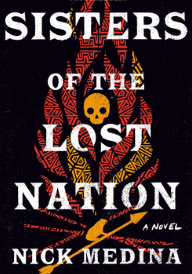
Sisters of the Lost Nation by Nick Medina

Amazon link (sponsored)

3.5 out of 5 stars

I liked this book less than Indian Burial Ground. From what I understand, Sisters of the Lost Nation was actually published first. I can say that the writing quality improved a lot between the two books.

This book shines a light on a very hard issue of addiction, exploitation, and lack of resources that Native Americans face in this country. People can get hurt or killed on the rez, and the law enforcement in the next town over would just shrug and do the bare minimum. Women and girls go missing, and nobody even pretends to make an effort to find them. It’s hard to read about, especially considering that even though the Indigenous tribe in this book is fictional, the issues are very much real.

The story itself, though… well, let’s just say that it took me a very long time to get into it. I think the author’s choice to jumble the timeline was a mistake. We are just getting to know Anna and her sister, as well as the other characters, and we jump from Day 30 to Day 4, back to Day 15, etc., in the first few chapters. This creates confusion.

More importantly, it makes Anna feel neurotic, because the Anna on Day 4 behaves completely differently than the Anna on the day Grace goes missing. Yet they are literally in back-to-back chapters. I couldn’t paint a clear image of who Anna actually is and what makes her tick until the timeline finally streamlined. And I admit that I didn’t like Anna very much until then either. And most of it was due to the time jumps back and forth and all over the timeline.

I also wasn’t particularly impressed with the ending. I felt like the author very much wanted to have a happy ending to this rather bleak story, but it felt forced rather than earned. In my opinion, a more realistic ending would have given this story an even bigger impact.

PS: My thanks to NetGalley for my review copy.
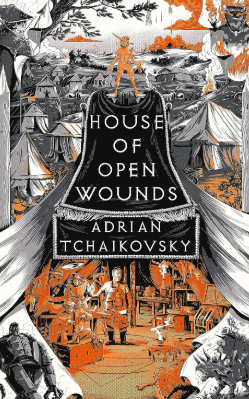
House of Open Wounds (The Tyrant Philosophers 2) by Adrian Tchaikovsky

Amazon link (sponsored)

Stars: 5 out of 5

I never knew that I needed M.A.S.H. in a fantasy setting before I read this book. It’s much better than the first book in the series.

One of the complaints I had with the City of Last Chances was the sheer amount of POVs we had to follow and how much they diluted the story. A lot of things were happening to a lot of people in different parts of the city, and it didn’t come together into one big picture until the very end. So the story felt disjointed and meandering at times.

In House of Open Wounds, the author chose to concentrate on the bloody day-to-day activities of a field hospital, so all the POVs are concentrated in or around the Butcher’s domain. This gives the story a lot more focus as well as lets the reader truly get to know and care for the characters. I grew to love them and hope for a happy ending for them, even if their prospects were bleak – they were magic users and priests of old gods in the middle of a Palleseen army, after all.

The only character to carry over from the first book is Yasnic, one-time priest of a healing god, and now self-appointed god-smuggler. However, even he underwent a subtle transformation in this book, where he goes by Maric Jack instead of Yasnic. I like him a lot better in this story than in the first one, because he seems to have a lot more agency. He is less whiny, and he shows depths of compassion that he wasn’t capable of in the first book. And he becomes, almost despite himself, the catalyst to all the events that happen in the book.

The other members of the Butcher’s menagerie are just as strange and broken, but also very endearing. I loved the two elderly priests of formerly rival gods who discovered that even though their religions had been eradicated, they still had each other. Or the long-lost heir to a kingdom who lived his whole life as an orderly… Heck, I loved all of them, even the very Palleseen necromancer who is unwillingly in charge of the whole experimental hospital.

The daily life in the Butcher’s domain is brutal and bloody, and even though we don’t get to see the war directly, we get more than enough of it in the wounds the hospital has to treat and the horrors that become their everyday routine.

I also really liked how this ended. That was such an elegant solution that used Yasnic’s God’s powers and loopholes and still managed to bring a little bit of justice into this brutal and unjust war.

PS: My thanks to NetGalley for my review copy.
Crossover (Cassandra Kresnov 1) by Joel Shepherd

Amazon link (sponsored)

Stars: 2 out of 5

I was so excited about the premise of this book. As I said – a military android who realized that she wanted no part in the war between the League, who created her, and the Federation, and defected to live a normal, civilian life. But even fleeing to a seemingly neutral planet of Tanusha, Cassandra ends up in the thick of secret plans within plans between the same two actors she tried so hard to distance herself from.

This should have been a heart-pounding thriller ride! Instead, I fell asleep and dropped my phone on my face at least five times while I slogged through this book. How can I book about a badass android who defected from the side that created her and ended up embroiled in a conflict on the world she ran to be so boring? It’s over 400 pages long, and trust me, almost every single one of those pages dragged.

One of the reasons is that the pacing is so uneven. We get moments of action when Cassandra is either in the thick of things or being pursued or doing some pursuing of her own. Those are exciting enough, even if they could have been more tightly written. The problem is, they are few and far between. And between them, we get a lot of Cassandra gazing at the city of Tanusha, Cassandra and other characters talking politics, human relations, and racism, or Cassandra thinking about sex or engaging in sexual activities. On and on, without adding anything meaningful to the story.

This brings me to my other issue with this book. Despite a lot of talk of politics, I still have no clue what the conflict between the League and the Federation was about. Why is the League losing the war? Why did they decide to cooperate with the Federation enough to literally turn over their very unique android model? It’s all vague references and a lot of circular talking, and no real answers. If I don’t know what caused the conflict, I don’t care about the conflict or either of the parties.

The whole worldbuilding is pretty shaky in this book. We are probably a few hundred years into the future (or thousands). Humanity seemingly colonized a lot of solar systems. Yet people still divide themselves by Earth race and religion? Why would it matter to a Tanushan that someone is Muslim or Hindu? In fact, how would you even practice your religion on another planet? Where is Mecca in regards to the planet you are on? In that respect, the world of The Expanse is a lot more credible. People stop being from China or America, or India by the second generation born on a new world. Instead, there would be Earth, Mars, the Belters, etc.

All in all, this was a boring and rather disappointing read, and I will not be continuing with this series. But at least I crossed another book off my TBR list.